
01 — Air
02 — Earth
Let's inquire together.
I sit with people who are in the middle of something they can't think their way out of.
We take a situation and with live questions, we look closely at it, together, until something becomes clear. An hour a week, one-to-one, free.
Maybe something has happened and the ground is gone. Or it could be that nothing has happened and the ground beneath you feels like it's gone. You've tried the things you know how to try and advice makes it even worse and you realize that you don't need another plan.
Or maybe it's quieter than that. You don't know what to do with what's showing up in your life, and everyone around you seems to. You've heard that you should let go of outcomes, and you'd like to, and nobody has told you how, or why it would help.
I won't tell you what to do. I'll sit with you while you see what you haven't been able to see. That's what I'm offering.
I know what that is.
I know what it's like to lose my footing in a room where everything is at stake. I know what it is to not know what my life is for. Oh, I know what it is like to grip an outcome so tightly that it couldn't have succeeded even if it tried. I know what it is to reach the middle of life with no tools for it: all the self-help collapsing, meditation failing, willpower powerless. See, I know what it is to be so afraid, for so long, that I tried every single thing and none of it worked. I know what it is to be so engulfed in the narratives of thoughts that I can't tell the difference between what thoughts are saying and what reality is.
What eventually helps, I find, is to look seriously and honestly with someone beside you, at the "who" it is that's going through the situations, events and stories of suffering. No, not a teacher, not a guru. Someone who knows what it is like to be in the pit and knows how to examine thought patterns and how they arise and collapse. The questioning itself becomes the door.
I do this for free because I wish someone had done it for me.
I know what that is.
I know what it's like to lose my footing in a room where everything is at stake. I know what it is to not know what my life is for. Oh, I know what it is like to grip an outcome so tightly that it couldn't have succeeded even if it tried. I know what it is to reach the middle of life with no tools for it: all the self-help collapsing, meditation failing, willpower powerless. See, I know what it is to be so afraid, for so long, that I tried every single thing and none of it worked. I know what it is to be so engulfed in the narratives of thoughts that I can't tell the difference between what thoughts are saying and what reality is.
What eventually helps, I find, is to look seriously and honestly with someone beside you, at the "who" it is that's going through the situations, events and stories of suffering. No, not a teacher, not a guru. Someone who knows what it is like to be in the pit and knows how to examine thought patterns and how they arise and collapse. The questioning itself becomes the door.
I do this for free because I wish someone had done it for me.
What we will do
We meet once a week for an hour. This would be without a strict curriculum. We will begin with whatever is actually happening for you, and we follow it inward.
The actual work is self-inquiry: turning attention inward toward the persona that's going through the life situation, toward the suffering itself. Most of us have only ever looked at the suffering itself. Most people have never been given room to look one step behind it, with company. It's slower than advice and it goes further, cutting through a lot of the escape routes of the ego.
So, what I will do is ask questions. I'll push back when something doesn't hold. I'll say what I see. I won't diagnose you, fix you, or hand you a plan. The clarity, when it comes, will be yours, because it was always yours.
03 — Philosophy
My philosophy
My founding philosophy is this: we are whole and complete. That's a birthright! However, life situations arise in a way that makes it feel like we need fixing. If there were anything to fix, it's the stories we tell about life, about ourselves, about others, about our circumstances. And the stories stem from something sneakier: a self we constructed, and then forgot we built. No such identity is what we are. What we are is the one who can see this. So we examine the stories, and the identity structure that holds them up, and we do it as sparring partners. That's where the sweet work is.
I think of this as a partnership. We might start with a career that has gone astray, a tiredness of life that sleep doesn't solve, or a relationship to success that has stopped paying. What opens up is a closer look at how you meet upheaval, uncertainty, and possibility when they come knocking. And they most certainly come.
It begins with honesty about where you are, without judgement and without shame. I have no judgement or shame in all of our conditioned situations. I have my own, and sitting with you shows me mine as surely as it shows you yours. I'm beside you in this, facing the same direction, with no vantage point you don't have. I find that when we stop outrunning what's uncomfortable and turn toward it, something in us sees what's true. From there, more becomes possible than our prior conception.
By midlife most of us have spent decades steering. The Taoists have a word for what we rarely try: wu wei, the action that arises when we stop forcing. Water finds its way down the mountain without a plan for the mountain. Much of what feels stuck is our own grip on how things should go, and as that grip loosens, life turns out to have been opening the whole time. Nobody can hand you this. You see it for yourself, in the letting go, and once seen it is hard to unsee.
None of this asks you to give up your ambition, your edge, or your vision. It makes room to feel, to listen, and to trust what you already know. To trust what you are.
The river was never lost or confused. Sit beside it long enough, with someone who won't rush you, and you'll watch yourself become the water.
04 — Approach
My approach
The work blends coaching, contemplative practice and inquiry, and attention to the body. I've trained in it for the better part of two decades and I would dare say my training runs deep, but I am not tied to a particular method. I begin with what's happening for you, and then reach for whichever of these the moment asks for. I borrow from a rich set of lenses. I am an ICF trained coach, a Co-Active and Integral Coaching practitioner. I was trained as a clinical hypnotherapist under Tad James as well as Timeline Therapy, and Neuro-Linguistic Programming (Master Practitioner). I have good knowledge of Internal Family Systems, systems thinking, and a long apprenticeship to the contemplative traditions (particularly Advaita and the Christian mystic traditions). Each of these has served as a different door and which one I use depends on what shows up in sessions.
Every pairing is going to be its own thing and so where we go depends on our timing, your questions, and what you're here for. For instance, we might be looking at the success script that has run your life, a decision you can't make, a season you don't have a map for, or the way you talk to yourself when nobody is listening. Sometimes there's a plan. But often we will let it unfold all by itself. That's the part I totally love.
Along the way I'll offer practices, readings, and prompts: a values inquiry, an audit of where your energy actually goes, a conversation with the one you're becoming, or a few minutes of noticing what your body already knows.
A few of the things we will lean on:
Looking one step behind
Most of us have only ever looked at our suffering, our situation and our conditioning. But for this we look at 'the one' who is suffering. The question is simple: are you this feeling, or are you aware of it? Asked slowly and very carefully, it does more than any amount of analysis. This is actually the spine of everything else on this list.
Taking the story to court
Every stuck place has a story holding it up: about you, about them, about how it was supposed to go. We write the story down and cross-examine it. Is it true? What happens when you believe it? Who would you be without it? Often the story doesn't survive the questioning, and what's underneath is much quieter.
Turning toward what resists
The part of you that argues, avoids, protects, or refuses has a reason. We stop fighting it and get curious about it instead. I have a PhD in arguing with reality, so I know the terrain. Resistance met with attention tends to loosen on its own.
Letting the body speak
The body usually knows before the mind can form a sentence. We slow down and notice the tightness, the heat, the pull, and let sensation lead for a while. This is where a lot of the thinking finally rests.
Removing all that's temporary (R.A.T.T.)
Anything that comes and goes cannot be what you are. Moods, roles, thoughts, the sense of being tired, even the feeling of being a self. We set each one aside, one at a time, and look at what remains. That remainder is the point of the whole practice and, in my experience, the sweetest thing a person can discover.
Small experiments
Insight that stays in the room doesn't count. We design one small, deliberate thing to try in your actual week, and you come back with what happened. You live your way into this.
Play
Sometimes the fastest way past a pattern is to stop being serious about it. A game, a drawing, an absurd question, a role reversal. Play interrupts the machinery in a way effort can't, and we'll invent whatever kind suits you. This is where the fun comes into play.
Meditation as a hobby (Maah)
We would examine what creating a practice of solitude, contemplation and spaciousness looks like for you. We won't be doing this to escape the world. Instead, we will do this as a practice that can shape even the busiest parts of your life.
Whether we sit together for a few weeks or a year, the aim is the same: to see clearly, and let your life reorganise around what you see.
Influences
I have had the privilege to learn from some of the best teachers, both in person and through their work. I pull from the work, exercises and inquiry of Byron Katie, Richard Bandler, Caverly Morgan, Connirae Andreas, Michael Brown, Sydney Banks, Gabriel Marcel, Cynthia Bourgeault, Michael Singer, Douglas Harding, Greg Goode, Jory Pryor, and from the wisdom of G. I. Gurdjieff. I have my self-inquiry grounding in the work of Atmananda Krishna Menon as well as Greg Goode.
05 — Water
06 — Fire
So far we've been talking about what we perceive.
Reflections, projections, perceptions. All of them are appearances. Water is the best teacher I know for this.
A wave rises and for a moment it seems to be a separate thing, with its own shape and its own trouble.
It breaks. That looks like an ending.
It was water the whole time. The wave was not something separate from the water. In fact, the wave has no identity of its own. So, nothing ever gets lost.
This is what the nondual and mystic traditions have pointed at for a very long time: the suffering and struggles in life are real manifestations. The one who suffers is not quite what we thought. Seeing that, directly, changes everything and nothing, all at the same time.
And when the wave has gone, something is still warm.
Inquiry is the fire that burns off the story, and what it leaves is the warmth that was there before the trouble started and is there after it ends. That's what we sit and look for. It was yours the whole time.
07 — Practicalities
How it works
Free. Nothing on this page is for sale, and I won't sell you anything on a call.
One-to-one, video call, an hour a week, open-ended.
Four people at a time, each in their own weekly hour. When the four seats are full, there's a waitlist.
The form below is the intake. The more you tell me, the better I can tell whether we can work together.
Everything you share stays between us, unless you explicitly say otherwise.
Recordings will be sent to you so you can listen again to what was unravelled. Some people choose to let their session be shared publicly, so others can see what this looks like. That's always your choice, always after the fact, and never a condition of working together.
This is coaching and inquiry, not therapy or medical care. If you are in crisis, in danger, or need clinical support, please reach that first: in the US, call or text 988, or contact your local emergency services. I'd still be glad to hear from you afterward.
08 — Voices
What people have said
I have always hated when someone says 'there's no you'. If there's no you, then who is there? Somehow, working with Seye helped me to see the confusion of language and what was obvious. And he did this very gently and without using confusing words.
09 — About
Who you'd be sitting with
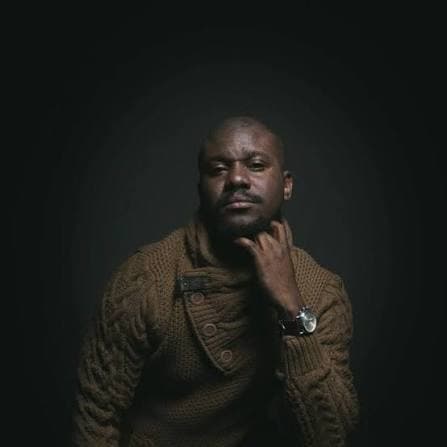
I'm Seye Kuyinu. I've spent twenty years helping teams and organisations change, and about as long sitting with the question of who I am. I write, I paint, I run a small meditation gathering, and I coach. My training runs through coaching, contemplative practice, hypnotherapy, NLP and systems thinking, and I don't begin with any of them. I begin with what's happening in the very moment.
10 — Questions
Things people ask
Why is this free? Is there a catch somewhere?
There's no catch. The sessions are free and stay free. I know what it feels like to not know how to navigate life as smoothly as I know it can be, and I believe your struggle is my struggle, your realization of completeness is mine too. So this is my way of making the world a little better. But I will disclose this though: some people choose, afterward, to let a recording be shared so others can see what that Aha! Moment looks like and over time that becomes a library of inquiry for you and for others (if you explicitly want this). And if we work together long enough that a paid three-month container would clearly serve you, I may mention it once, in writing, and never on a call except you bring it up. You can say no and nothing changes between us.
What exactly is a coach?
A coach is a partner in seeing. A teacher has something you don't and passes it to you. A therapist treats and heals. An adviser tells you what to do. A coach does none of these. I sit beside you, facing the same direction, and ask the questions you haven't been able to ask yourself. I'll push back when something doesn't hold, and I'll say what I see. The clarity that comes is yours, because it was always yours. I just hold the light steady while you look.
Who do you sit with?
Founders, creators, and mid-career people who are doing well enough on paper and still know something has to shift. Often they want to change how they hold work and life, and they can't do it from where they're standing. They're not after a quick fix or somebody else's playbook, and most are already close to a meditation or journaling practice. What matters more is that they do something with what we find, rather than waiting for the next session to do it for them. Come if you're willing to look at what's actually happening in you, and to stay with a large question past the point where it gets comfortable.
What do you mean by suffering?
Pain is what happens to us: a loss, a diagnosis, a door closing, a body that hurts. Suffering is what the mind does with the pain. It adds a story about what it means, a resistance to it being here, and an identity built around it: "I am the one this happened to." Psychologically, suffering lives in that added layer. Pain often can't be avoided. Suffering, once seen clearly, loosens on its own. That layer is what we look at together, and it's why the work is inquiry rather than advice.
What happens on the first call?
We talk about what brought you here. I'll ask a lot of questions. By the end you'll know whether this is the right room for you.
What happens in a session after that?
We start with a few minutes of silence and a check-in, go deep on one or two things, and leave time at the end for what came up to settle. I ask questions, mostly. Along the way I'll offer prompts, exercises, and practices that fit what we're finding, and I'll reach for a framework in the moment if it's the thing that helps. What we use depends on what you walk in with. Some sessions end in sharp clarity and an obvious next step. Others move slowly until something gives, and a memory or a truth or a decision surfaces that has been sitting just under the surface for years. I can't schedule that part. I can keep the room quiet enough for it to arrive.
How often do we meet?
Twice a month, sixty minutes. That rhythm leaves you room to live between sessions without losing the thread, and we'll change it if the season you're in asks for something else. Between sessions you can reach me by text, voice note, or email, whether it's a reflection, a bit of spot coaching, or something that won't keep until we next speak.
How long do people work with you?
I ask for a commitment of about two months, roughly eight sessions, and after that the work runs as long as it's still doing something. Some people stay three months, some a year. We check in as we go and adjust. No coaching relationship should last forever. This is meant to hand you back your own clarity and your own pace, and there comes a point where you don't need me for either. We stop when it's done, and you and I will know clearly when that is.
How long before I see results?
Some people feel a shift in the first hour. For others it takes months of steady looking. It doesn't move in a straight line, it moves in layers. You see something, you sit with it, you choose differently, and over time that becomes how you live. We watch for it in ordinary places: how you make decisions, how you are with the people closest to you, whether you trust yourself when nothing is certain. It usually shows up as something felt before you have words for it.
Do you follow a particular system?
I'm certified through the ICF and the ICA and trained in Integral Coaching, hypnotherapy and NLP, and I don't work from a playbook. I draw on Byron Katie's The Work, Sydney Banks' Three Principles, Greg Goode's self-inquiry, Internal Family Systems, Conscious Leadership, and meditation. Which of them shows up depends on what's happening in you that hour, not on a sequence I decided in advance. What stays constant is the attention I bring. The right work tends to surface on its own once someone is genuinely paying attention.
Is this therapy?
No. I'm not a clinician. If you're in crisis or need medical or psychiatric care, please get that first.
Do I need to know anything about meditation or nonduality?
No. Curiosity about your own experience is enough. We will most likely talk about meditation, in one form or the other, depending on where you are and what's happening with you.
Why only four people?
Because this kind of attention doesn't scale, and I'd rather bring presence into it.
11 — Begin
Let's begin
Tell me what's going on. I read every inquiry myself and reply when there's a seat.
The more you can tell me, the better I can tell whether I'm the right person to sit with you.
Not ready to work with me yet?
Start with three questions instead. About three minutes. I'll send you a reply and a short guided sit.